For most of the digital era, data was never the centre of the story.
Software was.
We bought software to fix problems. To automate processes. To scale operations. To improve efficiency.
Data sat quietly in the background, generated by systems, stored for reference, and occasionally analysed to explain what had already happened.
Its role was supportive. Its value was implied, but rarely explicit.
That mental model shaped decades of decision-making.
The Quiet Shift Leaders Missed
Over the last decade, markets repriced where value actually sits.
A basket of data-driven companies—Amazon, Google, Microsoft, Meta, Salesforce, Experian—steadily closed the gap with one of history's most trusted stores of value: gold.
Markets repriced data and intelligence long before organisations did
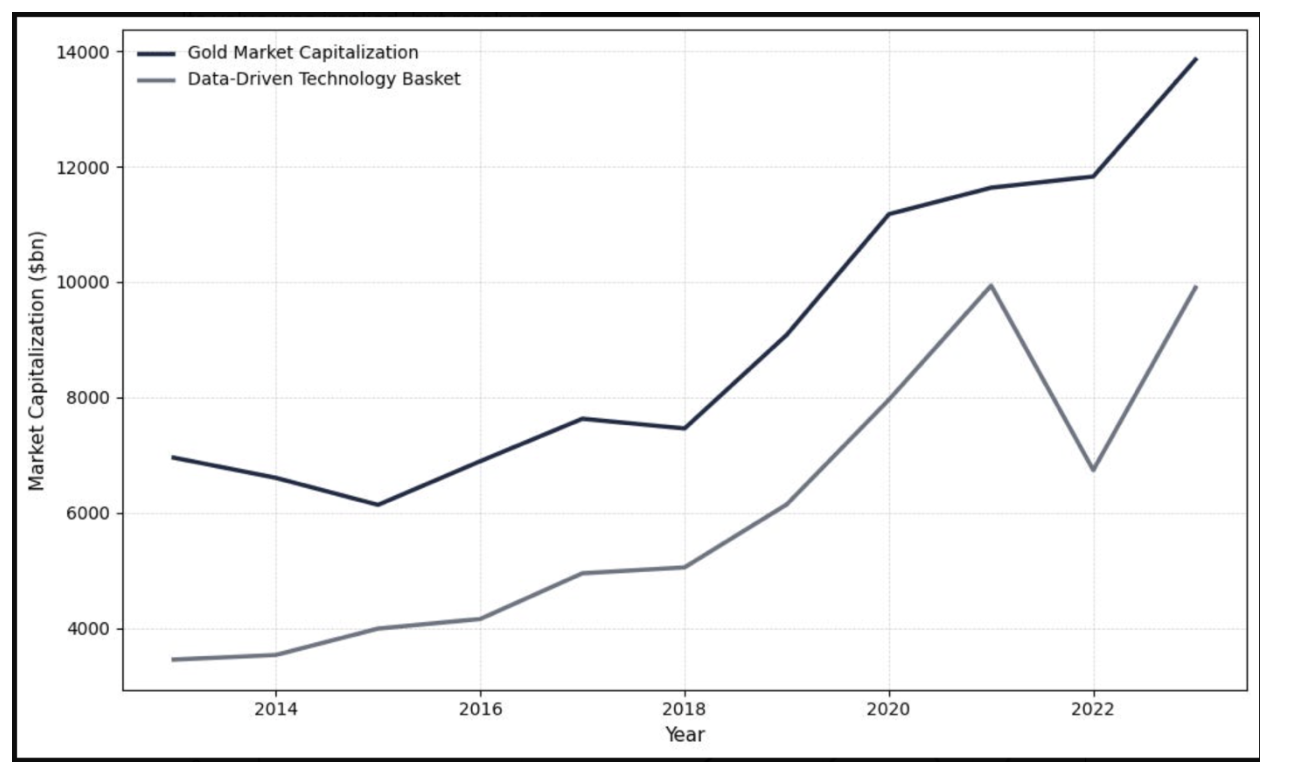
By 2021, that basket reached 85% of gold's market capitalisation. Even after volatility, it remains above 70%.
This wasn't hype. It was the market recognising that value no longer sits in software alone, but in data, learning, and intelligence.
Why Organisations Didn't Act
Most leaders sensed the shift. They still couldn't respond.
Not because data didn't matter, but because the system made action hard.
**First, valuable data was inaccessible.** Trapped in legacy systems, fragmented across silos, poorly defined.
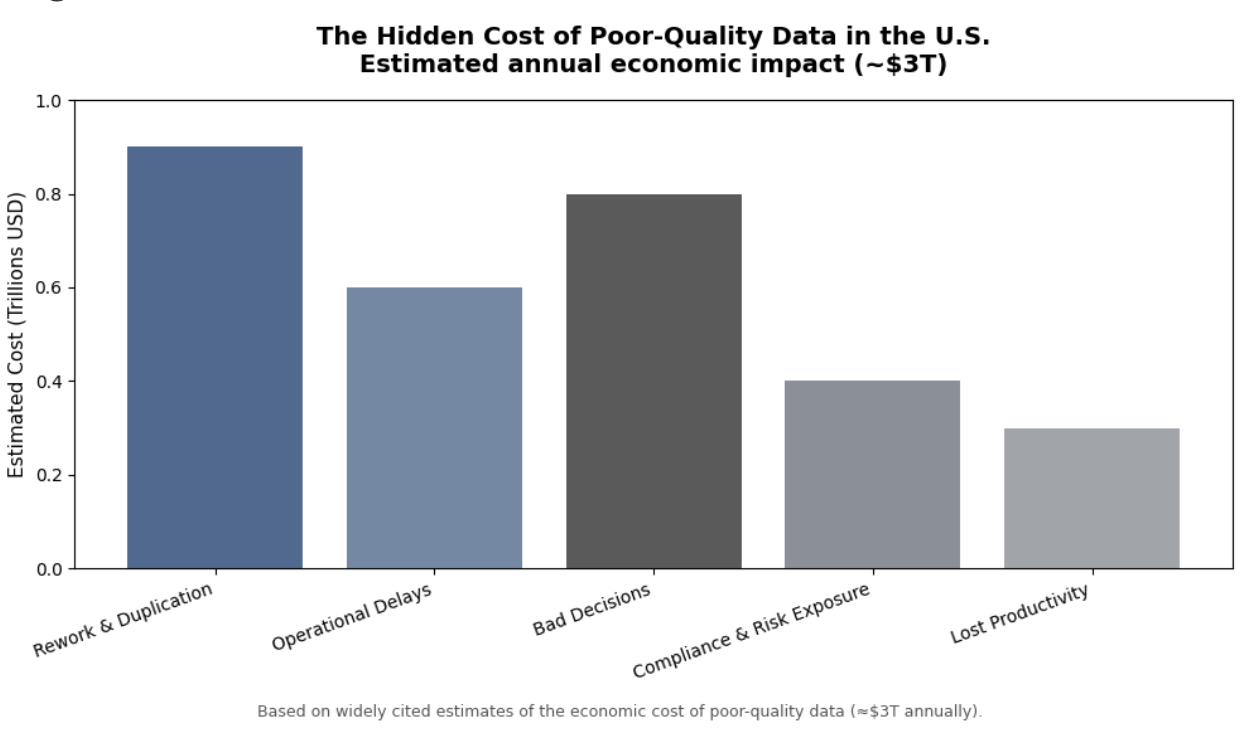
**Second, ROI was backwards.** Organisations struggled to justify the ROI to fund data initiatives even as they quietly paid for inaction through rework, errors, delays, and bad decisions. One widely cited estimate puts the cost of poor-quality data in the U.S. at $3 trillion per year, spread across the organisation, yet owned by no one.
Individually, these costs look manageable. Together, they create a systemic drag.
**Third, data never reached the boardroom as a value topic.** It lived under IT, risk, or compliance—governed, not strategised. As a result, data remained operational while strategy moved on.
**Fourth, governance crowded out innovation.** Innovation with data happened elsewhere, inside vendor platforms or shadow initiatives. Risk stayed inside the organisation, upside leaked out.
**Fifth, volume was mistaken for value.** More data created noise, not clarity. Value was buried under noise. Important data wasn't prioritised, protected, or designed for use. More data created complexity, and increased storage and management costs, not advantage.
**Finally, others defined the intelligence layer.** When understanding is weak, defaults take over. Vendors, platforms, and external systems quietly begin to define how data is structured, how models learn, how decisions are optimised.
By the time leadership notices, the rules are already set.
When Data Gaps Become Outcome Gaps
Once systems rely on data, missing data isn't neutral.
Boston's "Street Bump" app used smartphones to detect potholes. Wealthier areas generated more data, so they received more repairs. Lower-income neighbourhoods generated less data and became invisible.
This is what data deserts look like. And it's a preview of what happens as AI scales decisions—data gaps become outcome gaps.
Why AI Changes the Stakes
AI didn't make data important. It made data unavoidable.
AI systems don't just analyse information—they act on it. They scale decisions. They lock assumptions into feedback loops.
At that point, data stops being operational.
It becomes: - a trust issue - a reputational issue - a fairness issue - a strategic issue
In other words: a board-level issue.
The Question Leaders Now Face
Markets have already adjusted.
Organisations built on usable data and learning systems are being valued differently from those treating data as exhaust.
So the question is no longer: "What's the ROI of investing in data?"
It's this: "What's the cost of letting someone else turn our data into intelligence before we do?"
Because if you don't treat data as a strategic asset, you don't remove its value. You outsource it.
And in an AI-driven world, that's no longer just a missed opportunity. It's a liability.

Apply this thinking
Want this thinking applied to your business?
Book a 30-minute call with Michael to scope an engagement — a keynote, an executive briefing, or longer-term advisory.
Explore the topic