From Products to Journeys: The Birth of the Intelligence Layer
Across much of my career working across the end-to-end value chain of business, I kept encountering the same fundamental disconnect: customers rarely wanted the product itself — they wanted the outcome behind it.
Very few people truly want a mortgage. They want a home. Few people want to spend hours comparing insurance policies, coordinating utilities, or navigating fragmented booking systems. What people actually want is security, simplicity, convenience, and meaningful life experiences.
Yet for decades, digital systems were never truly designed around those outcomes.
The internet originally promised seamless connectivity, but modern digital experiences evolved into fragmented ecosystems of apps, platforms, interfaces, and isolated workflows. Even simple life events often require consumers to move manually between multiple providers, repeatedly entering the same information and navigating systems that were never designed to work together.
While digital transformation improved efficiency inside companies, it rarely solved the fragmentation between them. In many ways, the burden of integration shifted onto the consumer, forcing people to become operators of complexity rather than beneficiaries of simplicity.
Over time, however, companies like Uber and Airbnb demonstrated something important: when technology removes friction and connects fragmented services into unified experiences, entire industries can be reshaped around outcomes rather than products.
Now, a much larger shift may be beginning.
Recent developments in agentic AI from companies such as OpenAI, Alibaba, and others suggest we may be entering a new phase where AI no longer simply supports workflows, but actively coordinates them. These systems are moving beyond chatbots and assistants toward something far more significant, AI capable of connecting commerce, services, transactions, and digital interactions across entire ecosystems.
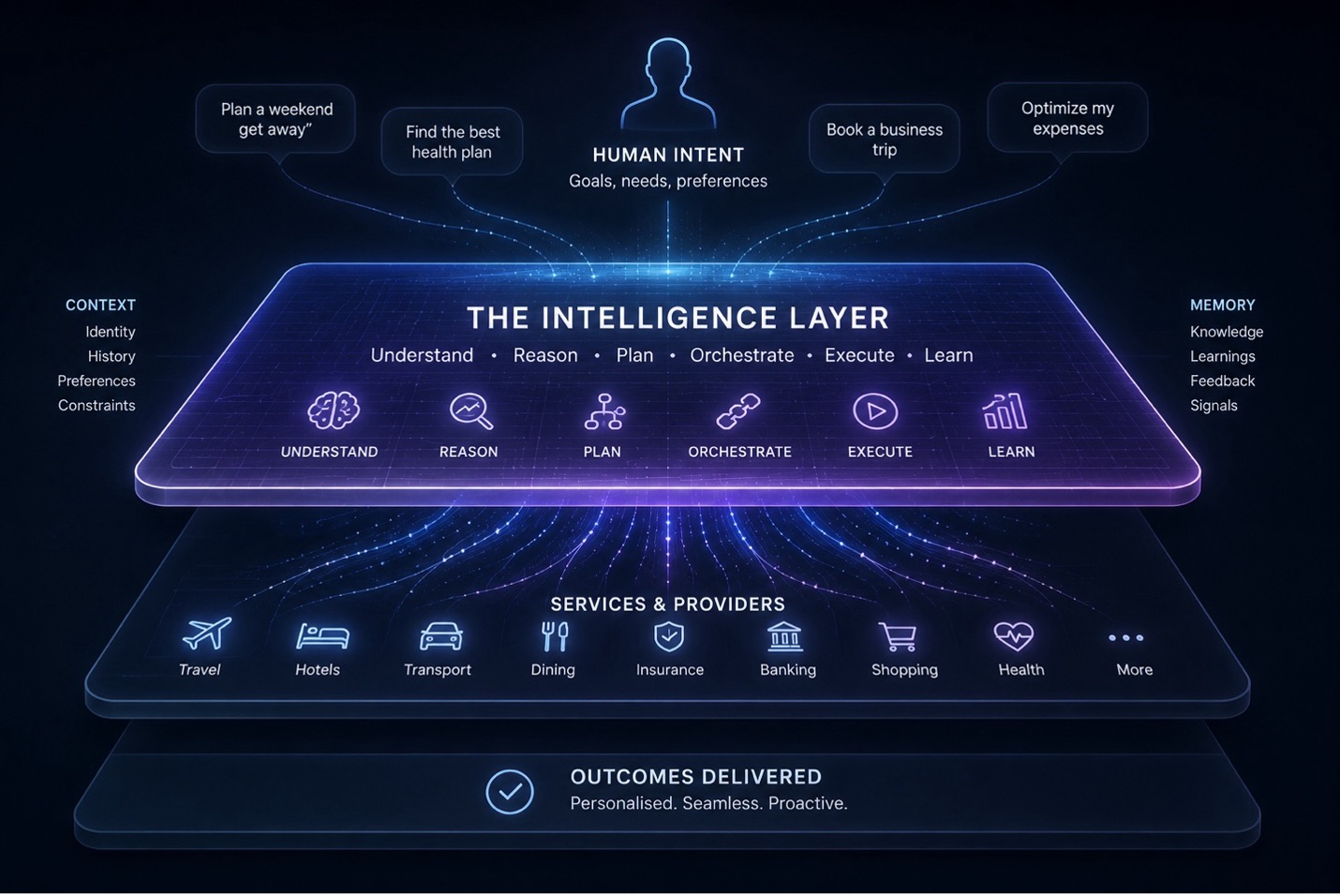
In many ways, this represents a shift from isolated applications toward interconnected execution layers capable of operating across platforms, providers, and industries simultaneously.
If this evolution continues, we may be witnessing the emergence of what could become the intelligence layer.
The Intelligence Layer
Rather than users manually navigating apps and interfaces, an intelligence layer would sit above the applications themselves, capable of understanding intent, coordinating services, managing identity, handling transactions, and continuously learning from user behaviour.
In such a world, apps do not disappear, but they may become increasingly invisible. The interface layer begins giving way to the intelligence layer, where intelligence itself becomes the primary mechanism through which people interact with commerce and digital systems.
From Transactions to Journeys
Historically, businesses competed around products, transactions, and touchpoints. But people do not experience life through isolated transactions, they experience it through journeys.
Moving home is not a mortgage product. It is a coordinated life event involving finance, insurance, utilities, logistics, legal services, and administration. The same applies to travel, healthcare, education, retirement, and personal wellbeing.
Agentic AI introduces the possibility that these fragmented experiences can finally become connected end-to-end journeys.
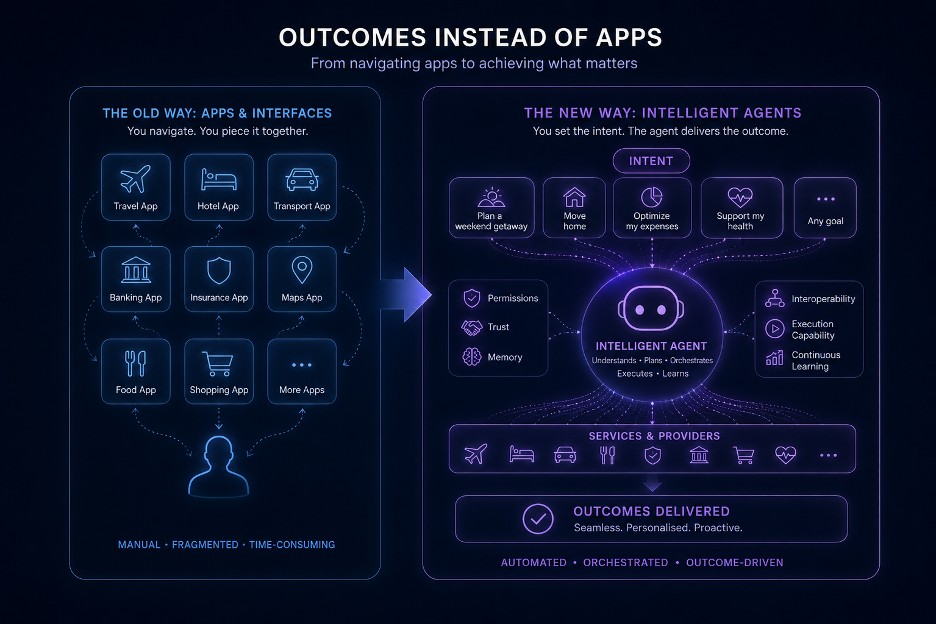
Over time, consumers may no longer open multiple apps to complete tasks. Instead, intelligent agents may increasingly coordinate outcomes on their behalf. The future of commerce may therefore become less about accessing software and more about achieving intent.
Who Owns the Intelligence Layer
The companies that dominate the next decade may not necessarily own the underlying products or infrastructure. Instead, they may own the intelligence layer that connects fragmented services into unified experiences. Just as Uber reshaped transport without owning vehicles and Airbnb reshaped hospitality without owning hotels, future leaders may coordinate entire life journeys without directly controlling every underlying service.
For decades, businesses competed for visibility through search rankings, websites, and app downloads. But in a world increasingly mediated by intelligent agents, discovery may become less important than selection. AI systems may increasingly evaluate, recommend, and execute decisions on behalf of users.
The battleground therefore shifts from being "top of search" to becoming "top of answer."
The implications extend far beyond software or commerce. Entire business models built around visibility, interfaces, and customer acquisition may need to be rethought. In many industries, the risk is not simply disruption — it is invisibility.
The companies, and perhaps even the individuals, that shape the next decade may not be those with the best products, but those that control the intelligence layer coordinating the journey.

Apply this thinking
Want this thinking applied to your business?
Book a 30-minute call with Michael to scope an engagement — a keynote, an executive briefing, or longer-term advisory.
Explore the topic